Chess Engine
The first project I built end to end in C++.

- Role
- Architecture · Engine · QA
- Team
- Team of 2
- Year
- 2022
- Stack
- C++14 · X11/Xlib · Make · OOP
This was the first project I owned from the empty file to the last QA pass — the CS246 final at the University of Waterloo, built with one teammate. No engine library, no framework: just C++ and the chess rules, written out one class at a time. It is the project where the abstractions I’d only read about in lectures — MVC, the observer pattern, smart-pointer ownership — first had to actually hold up under their own weight.
Problem
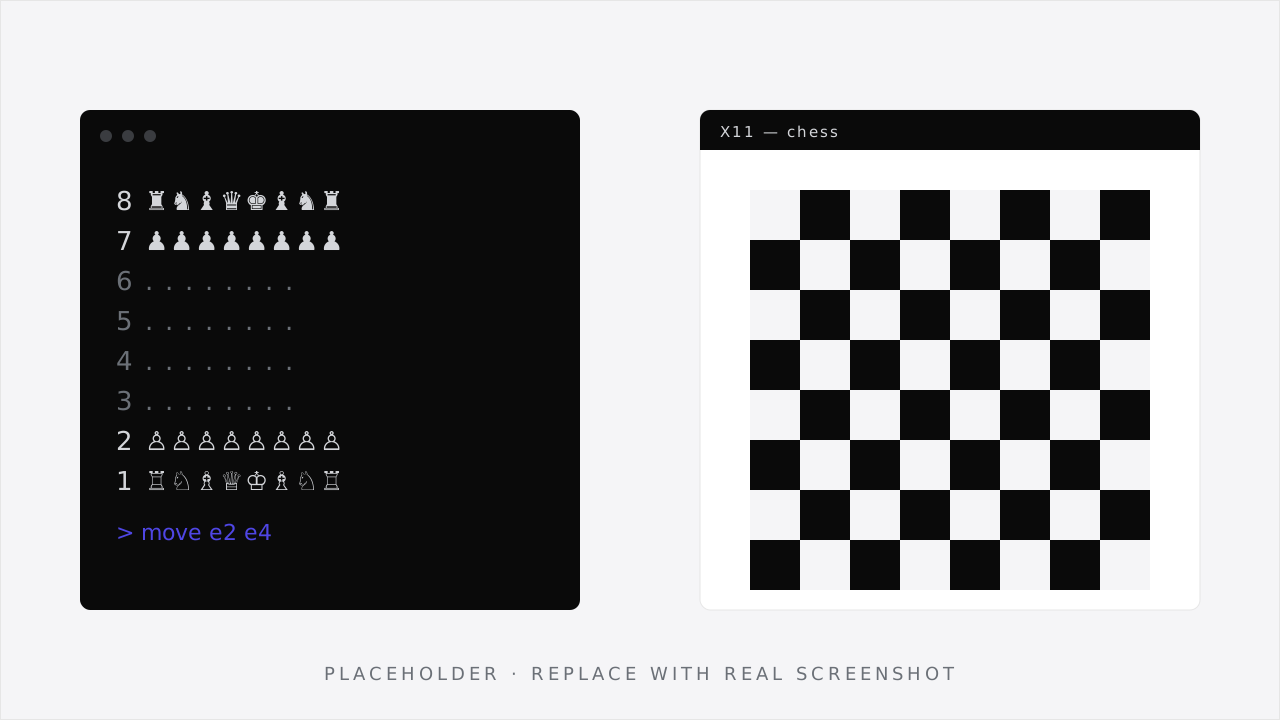
A full chess game is deceptively large. It isn’t one rule; it’s a web of them. A move is only legal if it doesn’t leave your own king in check. Castling depends on whether the king and rook have ever moved. En passant is legal for exactly one turn. A pawn reaching the back rank promotes. And on top of the rules, the game has to be played — by two humans, by a human against the computer, or by the computer against itself — and shown on screen, in our case on a terminal and an X11 window at the same time.
The trap with a project this size is that everything wants to touch everything. The board knows the rules, the rules want to redraw the screen, the screen reads the board, the AI pokes at all three — and within a week it’s a knot no one can change without breaking something three files away. The real assignment wasn’t “make chess work.” It was make chess work in a way that stays changeable.
- ~3.7k
- lines of C++
- 25
- classes
- 5
- AI levels
- 2
- simultaneous views
Approach
I designed the whole thing around three ideas from the course — high cohesion, low coupling, and resilience to change — and enforced them with structure rather than discipline alone.
MVC as the backbone
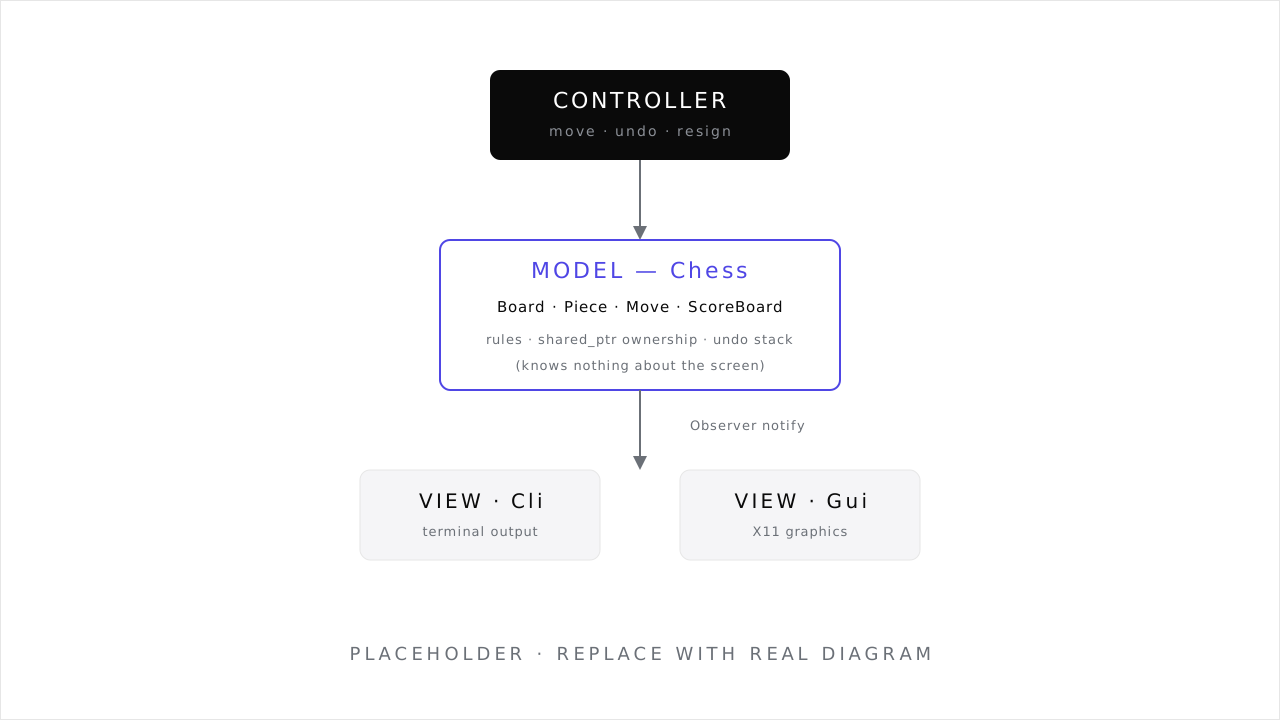
The skeleton is Model–View–Controller. The Chess model owns the game state and every rule and knows nothing about the screen. The views (Cli, Gui) only draw — they hold no logic. The Controller translates user input into model calls. The payoff is concrete: I could replace the entire GUI without touching a single line of game logic, and adding a brand-new view meant writing one class and attaching it.
Three design patterns, used for real
- Observer keeps the two screens in sync.
Chessis aSubject;CliandGuiareObservers. When a move lands, the model notifies every attached view at once — so the terminal and the X11 window redraw together, and the model never needs to know who’s listening. - Strategy makes the AI swappable. A single abstract
Computerinterface (virtual bool makeMove() = 0) has one implementation per difficulty. The game only ever talks to the abstract type; which level is actually running is injected at runtime. A new difficulty is just a new subclass. - Inheritance and polymorphism model the pieces. Every piece derives from an abstract
Piecebase — and even empty squares are realEmptyobjects, so every one of the 64 squares answers the same interface. Per-piece quirks (a pawn’s first move, a rook’s castling rights) live as virtual functions: share the common code, override only the difference.
The part that was genuinely hard: memory
Instead of hand-managing new/delete, the whole object graph runs on std::shared_ptr and RAII. The board is a grid of owning pointers (shared_ptr<Piece> bd[8][8]), so moving a piece is moving a pointer, not copying an object.
The design problem I’m proudest of solving is undo. To take a move back, the piece you captured has to still exist somewhere in memory — even though it’s gone from the board. So each Move on the history stack owns the piece it captured (and, for promotions, the pawn it replaced). Nothing is leaked, nothing is lost: when you undo, I plug that surviving pointer back into the board and the dead piece returns exactly as it was — with dedicated paths for castling, en passant, and promotion.
Coordinates that read like a board
Squares are a Position enum with a base-10 encoding (a8 = 0, b8 = 1, … a7 = 10), so row/column math stays trivial and the code reads in chess terms instead of raw indices.
Outcome
The finished engine plays full, rule-accurate chess — all six pieces, check / checkmate / stalemate, castling, en passant, promotion, and undo — across human, human-vs-computer, and computer-vs-computer modes, with a custom board-setup mode and a running scoreboard. The AI climbs across five levels — from random legal moves and one-ply heuristics up to an alpha-beta-pruned negamax search with positional evaluation.
More than the feature list, this is the project that taught me what structure buys you. Because the model never knew about the screen and the pieces shared one interface, I could keep extending it — another view, another AI level, another special rule — without the codebase fighting back. Carrying it end to end, including the QA, is why it still means the most to me.
Built for CS246 (Object-Oriented Software Development), University of Waterloo, 2022.