Dragon Slayer
The first real game I ever shipped — a solo Unity roguelike.
- Role
- Design · Gameplay · Systems
- Team
- Solo
- Year
- 2023
- Stack
- Unity · C# · uGUI · TextMeshPro
Chess was the first thing I built end to end in code; Dragon Slayer was the first thing I built that was a game. At the time I was hooked on mobile hack-&-slash roguelikes — the Vampire-Survivors loop of swarming enemies, level-up cards, and one more run — so I opened Unity for the first time and tried to make one myself, alone, on free assets. The point wasn’t to ship a hit. It was to find out whether I could turn a genre I loved playing into something that actually runs.
Problem
A survivors-like is simple to play and deceptively layered to build. You don’t write one mechanic — you write a loop that has to keep escalating without falling apart. Enemies spawn in waves that get harder on a timer. The player auto-attacks while you dodge. Killing things drops EXP; enough EXP triggers a level-up that pauses the game and asks you to draft one of three random upgrades; surviving long enough summons a boss that ends the run in a win or a loss. Then it all has to bank your gold and loop back to a lobby where that gold buys permanent upgrades for the next run.
For a first time in an engine, the trap is wiring all of that into scenes by hand — every card, every screen, every enemy dragged into the Inspector — until one missing reference quietly breaks the whole thing. I wanted the systems to build themselves so the game couldn’t fall over on a detail.
- 5
- weapons
- 14
- upgrade cards
- 4+1
- enemies + boss
- 0
- audio assets
Approach
I leaned on lightweight, self-bootstrapping systems so most of the game assembles itself at runtime instead of living in fragile scene wiring.
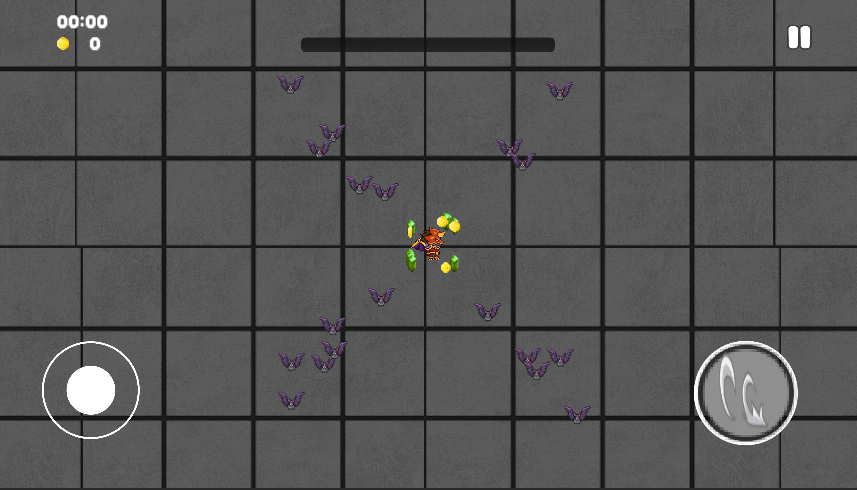
Auto-battler combat. The player fires automatically at the nearest enemy on an attack-speed timer, so the whole skill expression is positioning and dashing — exactly the feel I was chasing from the games I played.
Roguelike drafting. On level-up the game freezes and offers 3 cards pulled from a pool of 14 (5 weapons + 9 stat buffs), each card built in code over a custom frame. That single mechanic is what turns identical runs into different builds — a fan of fireballs, a burning aura, a black hole that swallows the screen.
One damage path for everything. Every enemy and the boss implement a single IDamageable interface, so all five weapons deal damage through one uniform route regardless of what they hit. Adding a weapon or an enemy never means special-casing the others.
Meta progression. Gold survives between runs through PlayerPrefs and is spent in a lobby shop on permanent Max HP / damage / move-speed upgrades, so a lost run still moves you forward — the hook that makes “one more run” work.
Outcome
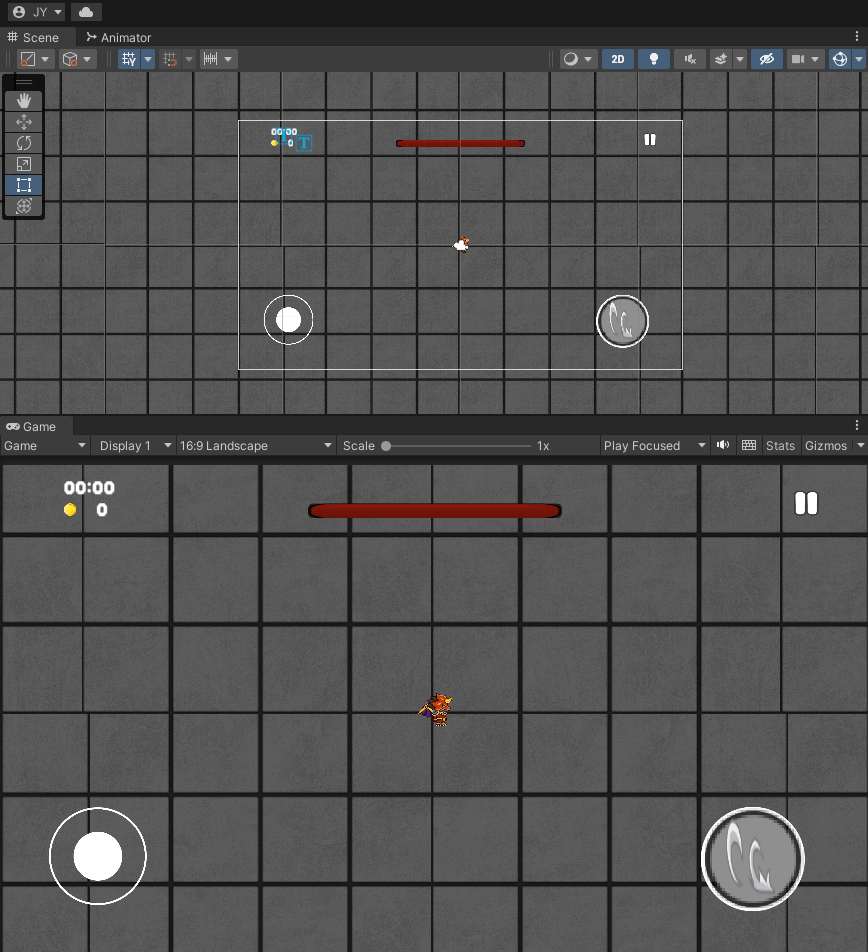
Dragon Slayer is a complete, actually-playable game: a full run resolves in a win or a loss, the difficulty ramps every 45 seconds until the boss, and your banked gold carries into the next run through the lobby shop. Five weapons, fourteen upgrades, four enemy types and a boss, all stitched into one escalating loop — assembled on top of free Unity assets and a lot of first-time trial and error.
What I actually walked away with wasn’t the feature list — it was the instinct to build systems that hold themselves up. Generating UI in code and synthesizing audio at runtime meant the game stayed solid while I was still learning where every button in the engine was. It’s rough around the edges, and that’s the honest charm of a first game: I wanted to know if I could make the thing I loved playing, and the answer turned out to be yes.
My first game, built solo in Unity, 2023.